
Living Without Running Water
A Collision With Convenience

If thou wilt make a man happy, add not unto his riches but take away from his desires. Epicurus
For the multi-generation families of Tasmania, it is not uncommon to have a shack. A rudimentary structure, likely up in the mountains or down by the seaside. It was a mainstay of the carefree summer holiday.
They’re still about.
However, like most gents approaching middle age, they’ve managed to pile on a fair amount of cushioning over the years. Or they’ve turned up their toes prematurely.
I have one, although not with the right amount of cushions. This became apparent when we attended a function organised by the parents at our son’s new school. “The Shack” is a common topic of conversation, and with one parent, also a shack owner, the suggestion was made with convivial generosity that we could trade shacks for a summer — for something different.
Once I pointed out that one of the “cushions” that I was missing was running water, the offer was quickly withdrawn with a scoff: “Good luck with that!”
In hindsight, that wasn’t a bad thing. I’ve become very fond of the shack and the idea of handing it over to a parent at the local school now seems less appealing. We did it once. It didn’t go well.
Around 1 in 4 people globally lack access to safely managed drinking water (World Health Organisation). For many without it, that means travelling long distances, often on foot, to collect and carry what they need. It has a direct impact on their health and development opportunities. Yet, like a fish underwater, the invisible infrastructure supporting the West’s ready access to clean drinking water, is largely taken for granted.
The modern home doesn’t have a single drinking fountain in the corner. There are sinks, washing machines, toilets, baths, showers, swimming pools and dishwashers. If you ask most where the swimming pool came from, they’d simple say that they earned it. Which is to avoid the question, but asserts, nonetheless, that they deserve it.
For many, the swimming pool is more important for what it symbolises than for what it is.
No one can live without water. I am no exception.
So how do I survive at my waterless shack?
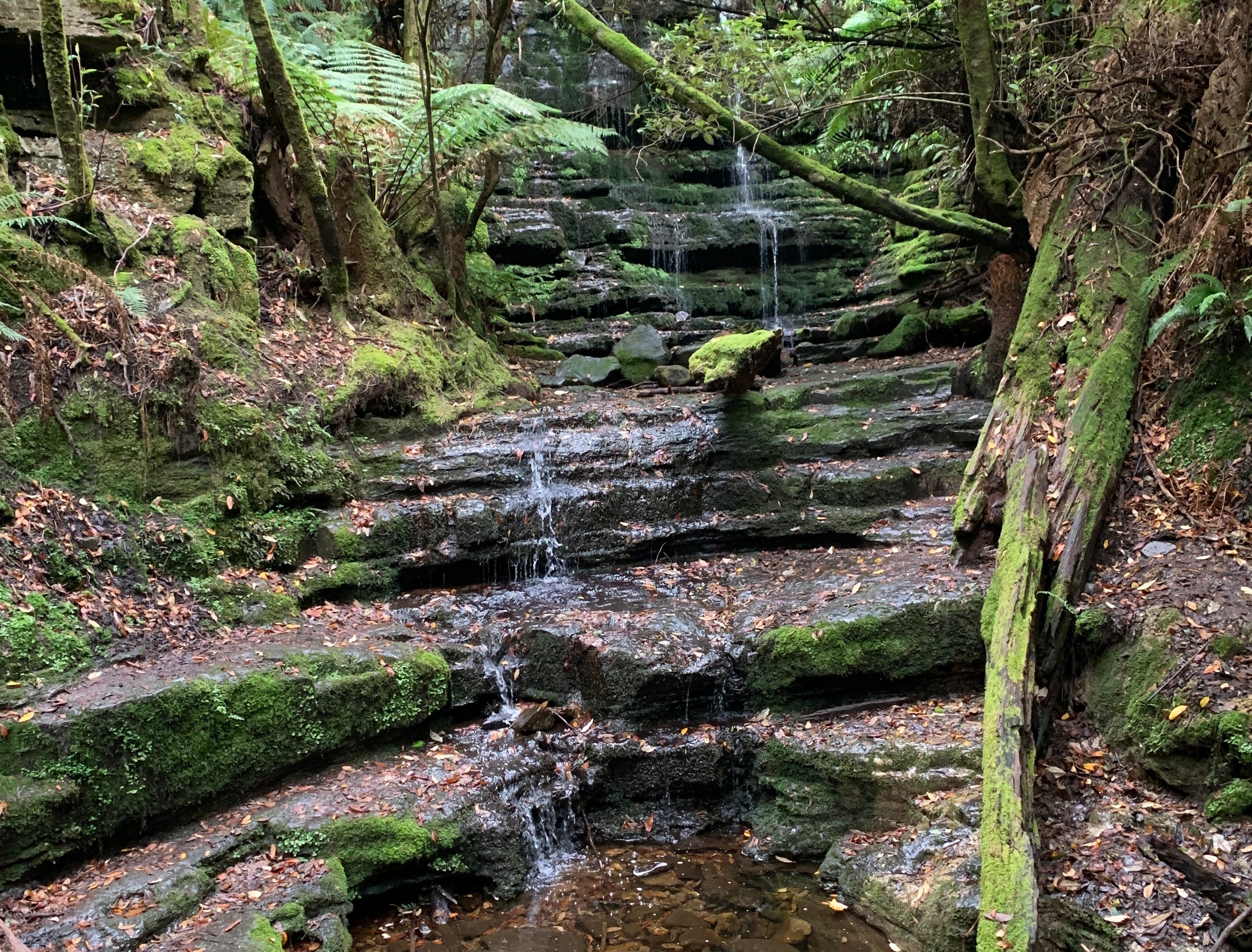
Stepping out the side door, it’s a gentle stroll down to the mountain stream at the bottom of the garden. Last week, in early summer, there was snow on the peak behind the shack. This is the source of the creek. Upstream from my shack there are a few others, although like mine, they aren’t occupied throughout the year.
This is the first source of potential contamination.
Everyone is reliant on the creek and it’s in all of our interests to keep it clean, which most do fairly well. Visitors are often the worst offenders with their desire to re-enact a shampoo commercial, with little regard for the locals.
The other main source of contamination is dead wildlife. Fortunately, there are no roads above us, so roadkill is mostly not an issue, although a struck animal can stagger a fair distance before dying. Animals still die from disease and can also be poisoned, intentionally and unintentionally, by human activity.
As I get older, I’m reluctant to drink directly from the creek, for these reasons, but in nearly twenty years, I haven’t been sick once, although I have suspected that it is the source of an occasional upset stomach. Needless to say, the kettle gets a good workout for boiling water.
These are the practicalities of survival and it’s certainly less challenging than what millions have to face. To look around my hometown, it’s clear that most have moved well above any survival baseline into what two hundred years ago, would have looked like a fully featured castle with every convenience.
If my circumstances were to evoke one word in my fellow citizens it would be this: Inconvenient.
When I think of convenience, the first thought is of a solution that makes something easy. However, more deeply, it is intended to indicate things coming together in an agreeable fashion. To be inconvenienced is to have your schemes torn apart. In the glib world of customer-centric corporate speak, inconvenience is routinely positioned as the most egregious failing of all. I apologise if that sounds inconvenient.
Where does water come from? A tap.
Convenience doesn’t merely remove an unpleasant task, it removes our understanding of what the task requires.
Food comes from the refrigerator. Entertainment comes from a screen. Thinking comes from AI?
Is trading understanding for convenience an eternal benefit? Despite living in a world that has prioritised convenience as an ultimate good, why are we currently swimming in a sea of psychic chaos?
Some might say that we have become detached from nature, but really, what we’re losing is a true understanding of the nature of things. This impacts our decisions in life.
Water does not come from a tap.
Trust the Process
As an engineer, surely my first inclination would be to build the infrastructure? Pumps and pipes. Tanks and taps. Yet, I’ve seen it more than once, standing on a country block with the new owner as they opine on the beauty of nature, getting back into the wild with the trees and the birds. And their first action within their newly acquired slice of heaven? Bulldoze the lot.
There is no building your way to nature. In fact, the real pathway is to stop doing the usual pyscho-status, convenience-driven actions and to just smell the gum leaves for a moment.
Smelling gum leaves and fishing in the river are wants I’m happy to have met, so when it comes to the water, I’m more prone to ask: What do I need?
I have a ten litre water container which I can fill by hand in the creek. Full, that’s ten kilograms or twenty pounds. Well within my carrying limit.
Western Culture’s Obsession With Doing Something
I am as guilty of creating convenience and seeking comfort as anyone. We find ourselves fixated on progress, often in a way that doesn’t allow us scope to consider what progress might actually be. We lionise “work” as the zenith of human activity, our moral judgements hinging on a perception of a person’s employment, or lack thereof. Yet circumstances can evaporate these apparent needs quite quickly.
What are some of the things I give up?
The first thing to go is the shower. Most of my country friends are usually decked out in work boots and dirty jeans. The demands for corporate cleanliness don’t exist.
There is no washing machine or dishwasher. The lack of a shower certainly limits the need for a washing machine. The dishes are washed by hand with as little water as is practical.
A single ten litre container is therefore usually sufficient for an entire day to cover drinking water, coffee, food preparation, personal hygeine and dishwashing.
Bored to Life
Necessity being the mother of invention isn’t as relevant when most of our physical needs are already met. Clinging to such a notion has spiralled into an unnecessary sea of over supply and over consumption. Yet, the Western obsession with “doing something” makes this pattern difficult to break.
It has also been said that boredom is the mother of invention, and when presented with what may seem like neccesities and boring tasks something else happens. Nature becomes more visible. And the more visible it becomes, the more wondrous it seems. The fresh air, the babbling brooks, the walls of green and the plentiful wildlife are constant reminders that we are of this world, not above it.
Soon, FOMO starts to look more like a prison than an aspiration.
Carry Water, Chop Wood
Never have four words so been in search of meaning. As I look for my own meaning I’m sure that chopping wood takes considerably more effort than carrying water, but then, I don’t have to carry the water that far.
The irony of modern living is that our backyards are dotted with tiny reservoirs and oases. Some call them swimming pools. And yes, they’re full of that most precious of commodity, water. Yet, we’ve done the strangest thing to this water, we’ve poisoned it with chlorine. Even when we bring the natural world into our homes, we ignore the way in which we have tortured and contaminated our precious water in order to make it sit quietly in this corner.
Presence & Perpetual Energy
We’re informed these days that one of the most important psycho-social skills is being present. Active listening. Being in the moment. Now! What if the demand to deliver my presence here and now defies the laws of thermodynamics? What if the world is demanding layered dynamic abstraction HERE, NOW! when I’m a snail, following a natural linear process?
I’m not sure I like these new ways. All of a sudden, I’m thinking about my presence in a way I never did before. In a way I never needed to in the past.
The truth is naturally full of details, whereas the approved social rhetoric, by its very nature must be limited in scope. Presence, with its vaguely specific connotations, feelis like there is something missing that is sitting just off the edge of the screen. We know we should be showing up with truth, society says so, but we’re somewhat confused as to how we’re supposed to it in the authorised fashion. Once again, issues and actions that society should be addressing as a whole, are being are being imposed on the individual.
Absence & Dissipating Energy
The word — energy — conveys both a scientific, mechanical meaning and a poetic one. There are units of energy, and sometimes, I just don’t have the energy to get out of bed.
And if there is one thing that modern society hates, it’s people who don’t get out of bed. Others might say the only something worth doing is nothing.
We often see convenience as a valuable addition to our current circumstances, rather than something that is leading us somewhere different entirely. I look around me and see that much of the cultural richness that has been built up over millennia is now either absent or being significantly dissipated.
Since the dawn of humanity, the river has been the great convenience store, with all the earliest human settlements being directly connected to a river.They are also a great source of cultural significance, from The Blue Danube to Take Me to the River.
There have been few odes written to the wonders of domestic plumbing.
More than at any other time in my life, I see us living in a state of cultural and political crisis. The Western inclination is always to find a new way, on the assumption that we haven’t and don’t want to lose anything that has gone before. But there is so much we’ve lost and our obsession with “building new” has led us here. This is not a coincidence.
Our minds are filled with conflicting instincts. Many of these conflicts arise because the circumstances in which these instincts were forged no longer exist. As many of our natural instincts lead us towards convenience, to understand how these instincts lead to our detriment we must first get an understanding of why they were forged in the first place.
Shedding material desires, as Epicurus suggests, does have a mysterious habit of bringing happiness. If there is one thing the affluent resent about the poor, it’s that they enjoy the music just as much as they do.
So begins the journey.
Author’s Note
Recently on Substack, May More 💜 put this together:

May asked us what our guiding word for 2026 was going to be. Mine turned out to be (in)convenience. As a result, I’ll be tackling this issue from a number of angles.
The first attempt at this topic was the feature essay in the December 2025 edition of my newsletter, The Red Telephone, entitled: The Doomer Consumer Apocalypse. You can read it here:
The Doomer Consumer Apocalypse
As always, balance is crucial. An unreconstructed return-to-nature has its own perils, too. Up next, I’ll be reviewing Werner Herzog’s Grizzly Man.
Interesting piece, Robert. Really makes one think. I'm far more in tune with nature than most, and I think I'd like to go back in time, but no running water? I've never even considered it. My husband and I will eventually move to Belize, and we intend to scale way back on our conveniences and material 'needs.' But what I'm picturing is still more luxurious than what most Belizeans have. And as you say, they seem far happier than most Westerners. Even if we don't want them, those Western expectations are still there, somewhere in our minds, and I don't imagine we can ever get rid of them. I've worked with a lot of Mexican immigrants throughout my life, and being around them always brought out a certain type of envy. They always seemed so content and easy-going, no matter how hard the work was, or how long they'd been there, or how hot it was. No matter what was going on around them, they were smiling and joking around, just grateful to be alive and employed. And somewhere nearby were their frowning American coworkers. No matter how hard I try, I don't know if I'm capable of experiencing that same level of contentment.
Dear Robert, how this resonates with me. This coming from a man presently unemployed since April, 2023, and who has every convenience, in terms of survival at least. But this also means I seek ways to connect with nature, with that connection (often) being the only purpose, and I fantasize regularly about living closer to the Earth. Nature is truly wondrous, and I don't agree with how we destroy it for this convenience. And I don't believe the convenience brings us more joy, only allows more time to fill, usually with work. Most people are so obsessed with money... there's always a void to fill... meanwhile, my outdoor walks (generally ranging 1-3 hours, with the occasional 4-5) could nary be replaced. What we have doesn't feel like progress to me, only forced change. I wouldn't doubt that certain ancient societies lost to our annals lasted much longer, with less "progress" as we recognize it, simply through the prioritization of natural well-being, for the Earth and ourselves. Most jobs today are unhealthy for the Earth and the worker, while the product is unhealthy for the consumer alike. This isn't to say I don't appreciate any modern inventions, especially as life wouldn't be the same without my Marshall amplifier to plug the Ibanez into... as much as I love playing unplugged too... but how nature is wondrous. And a great part of me is desperate to learn how to live with it more closely. More harmoniously. And perhaps someday I'll work it out. I truly appreciated this read.
I'm still thinking about: "We know we should be showing up with truth, society says so, but we’re somewhat confused as to how we’re supposed to it in the authorised fashion. Once again, issues and actions that society should be addressing as a whole, are being are being imposed on the individual."
This has also been heavily on my mind lately, as I feel powerless to change things that can only be impacted by the involvement/withdrawal of many others with me, yet endeavour to make a change anyway. I myself not living the life I believe I should be living is a gigantic obstacle however, I'm realizing presently... so yeah, it's a whole thing. I have so few needs, and happiness comes to me easily, the more aligned I live with my beliefs. I'm confident I can pull it off, if I learn the ways. I can certainly set an intention of it.
You're awesome, man, thank you for sharing this. I'll review my notes before meditating tonight. I started again yesterday. Take care for now.